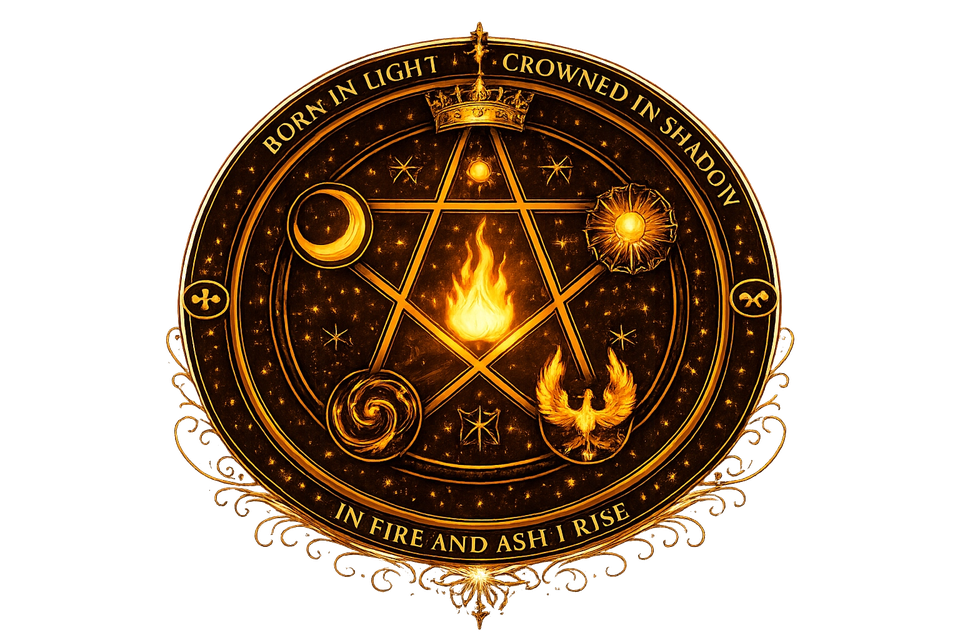
The human body is a cyclical organism. The circadian rhythm that governs sleep and waking is tuned to the rotation of the earth. Hormonal cycles follow rhythms measured in weeks. The deeper rhythms of mood, energy, creative capacity, and physical vitality move in patterns that most people, when they begin to track them honestly, discover are more organized and predictable than they had realized.
This is not coincidence. Living systems are not separate from the natural cycles that organize life on this planet. They are embedded in those cycles. They respond to them. When the alignment between a person's practice and the cycles of the natural world is recognized and worked with deliberately, the practice gains access to fields of force that are already moving — rather than working against natural currents or in oblivious independence of them.
The Moon as Scaffolding
Lunar practice is perhaps the most accessible entry point into cyclical magical work, because the moon's phases are visible, trackable, and correspond to a rhythm (roughly 29.5 days) that is physically real and has measurable effects on natural systems from ocean tides to plant growth patterns to, according to a significant body of research, certain aspects of human physiological and psychological experience.
The four primary phases offer a natural framework for organizing magical work across the cycle. The new moon — the moment of beginning and seeding — is traditionally aligned with intention-setting and initiating new projects or practices. The waxing moon, as the light increases, aligns with building, expanding, adding energy and momentum to what was begun. The full moon, at peak illumination, is the moment of fullest manifestation — also of greatest visibility, and therefore of revelation, both of what has ripened and of what has been hidden. The waning moon, as the light decreases, aligns with releasing, clearing, and completing cycles.
"Working with the moon does not require belief in lunar magic. It requires only the honest recognition that you are a cyclical being living on a cyclical planet, and that moving with the rhythms available to you uses less energy than perpetually moving against them."
Seasonal Turning Points
The eight-spoked wheel of the year — the four solar points (solstices and equinoxes) and the four cross-quarter days between them — offers a larger temporal scaffolding for magical work across the annual cycle. This structure appears in Celtic, Norse, and other Northern European traditions, but corresponding ritual calendars organized around the agricultural and seasonal year appear across virtually every culture that has lived in relationship with natural cycles.
Working with seasonal turning points is not about adopting any particular tradition's mythology or practice wholesale. It is about attending to the actual qualities of each point in the year — the particular quality of darkness in deep winter, the stirring and uncertainty of early spring, the fullness and extroversion of midsummer, the harvesting and composting of late autumn — and aligning your inner work with the quality of the outer season.
Beginning Simply
You do not need elaborate ceremony to begin working with natural cycles. Begin with simple noticing: track the moon's phase for a full cycle and observe, honestly, your own energy, mood, creative capacity, and inner state at different points. Track the seasons and notice how your inner world changes in correspondence with outer conditions. Let the observation precede the practice.
The most sophisticated magical practice is simply a more deliberate version of what nature is already doing. Working with natural cycles is not about adding external structure to your practice. It is about discovering the structure that was already there, and learning to work with it rather than in ignorance of it.