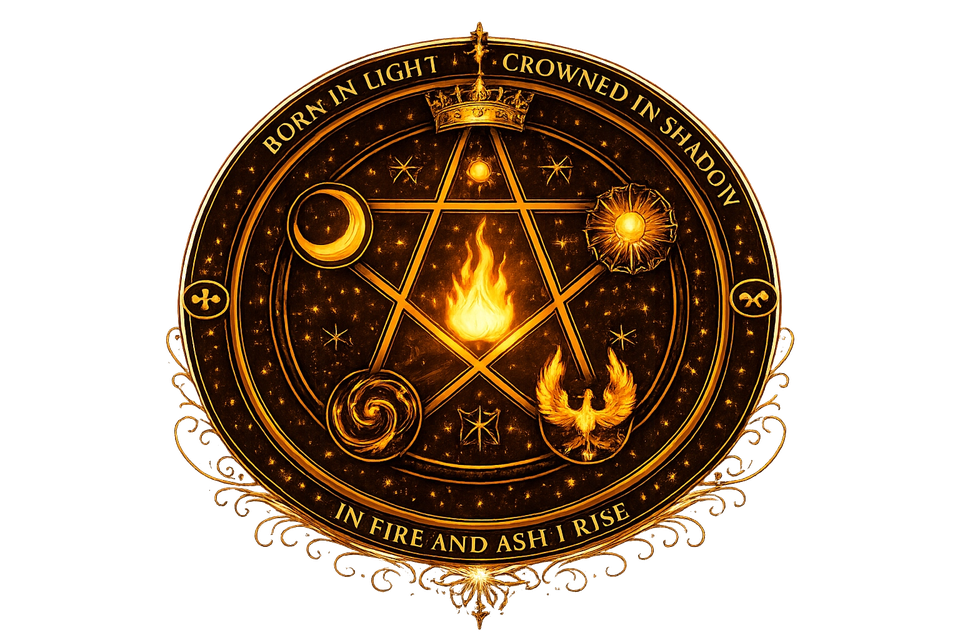
There is a moment in every serious practitioner's development when they stop treating symbols as aesthetic choices and begin to understand them as language — a language older than written speech, more immediate than cognitive thought, and capable of moving in both directions: out from the self into the world, and in from the world back into the self.
This is what the Sacred Signs Atlas is built around. Not symbols as decoration or tradition, not symbols as borrowed authority — but symbol as living, bidirectional communication between a sovereign practitioner and the animate field they move through.
Why Symbols Are Technology
Technology is any tool that extends what the human body and mind can do alone. Writing is technology. The wheel is technology. And symbols — particularly working symbols chosen with intention and engaged with consistency — are among the oldest technologies available to conscious beings who want to shape their relationship to the invisible currents moving through their lives.
A symbol does something specific: it collapses a complex field of meaning into a single form that can be perceived in an instant. The body recognizes a working symbol before the mind can analyze it. The nervous system responds. The emotional field shifts. The entire associative web of meaning that has been built into that form — through culture, through personal history, through deliberate working — activates simultaneously, without the delay of sequential thought.
This is why symbols are used in advertising, in propaganda, in religious practice, and in magic. The mechanism is the same across all of these contexts. The difference is in whose hands the symbol is held and toward what purpose it is aimed.
"The question is never whether symbols have power. They do — regardless of whether you acknowledge it. The question is whether you are working with that power deliberately, or whether it is working on you without your awareness."
The Living Symbol System
What the Sacred Signs Atlas calls the living symbol system is the evolving, personal symbolic vocabulary of a practitioner who has taken responsibility for their relationship to symbols — who understands which ones they have inherited, which ones they have chosen, which ones have been working on them without their consent, and which ones they are in the process of deliberately building.
This is not a static inventory. A living symbol system grows and changes as the practitioner grows and changes. Some symbols that were once powerful will retire, their charge spent, the work they were serving complete. New symbols will emerge — from dreams, from synchronicities, from deliberate practice — and take up residence in the working field. The practitioner's relationship to their own symbolic vocabulary is itself a practice: one that requires regular tending, honest assessment, and the willingness to release what no longer serves even when it once meant everything.
Co-Creating With the Unseen
One of the most striking aspects of mature symbolic practice is the experience of the symbol system working back at you — of synchronicities organized around symbols you have activated, of meaning arriving through the precise vocabulary you have developed, of the unseen responding in the language you have learned to speak.
This is not coincidence, and it is not delusion. It is what happens when a sufficiently developed attention meets a responsive world: the field of meaning becomes a genuine conversation rather than a one-way broadcast. You speak in symbols. The world answers in kind.
The Sacred Signs Atlas is a guide to this conversation. Not to the symbols themselves — though many are explored within it — but to the relationship between a sovereign practitioner and the language of meaning that is always already moving through their life.
You have been surrounded by symbols since the moment of your birth. The question is whether you are reading them — or whether they are reading you.